Romance fraud costs UK public over £80m per year
Data gathered by Capital Refund House reveals that the UK public were defrauded of more than £400m in just five years as a result of romance fraud.
Known as either romance scams or dating scams, this type of fraud involves scammers preying upon people looking for a romantic connection.
The data, which comes from members of the public reporting crimes to Action Fraud, indicates that there were nearly 40,000 cases of romance fraud between January 2020 and December 2024.
As the figures are based only on those who reported the crime, and account for the amount that victims initially believe they have lost, the true figures could be much higher.
Get support from fraud experts
Romance fraud is just one way in which innocent people are being defrauded. If you’ve lost out because of a scam, you may be able to claim your money back.
Just speak to Capital Refund House today for guidance and learn if you could be entitled to compensation. You could be connected to a professional who would use their experience and expertise to help you get what you deserve.
Simply call +1 (206) 609-6016 or get in touch online for 24/7 support.
In depth – over £400m worth of financial loss
Dating fraud involves a scammer, often through ‘catfishing’, tricking their victim into sending them money. Such scams can originate on dating sites, social media platforms or online forums.
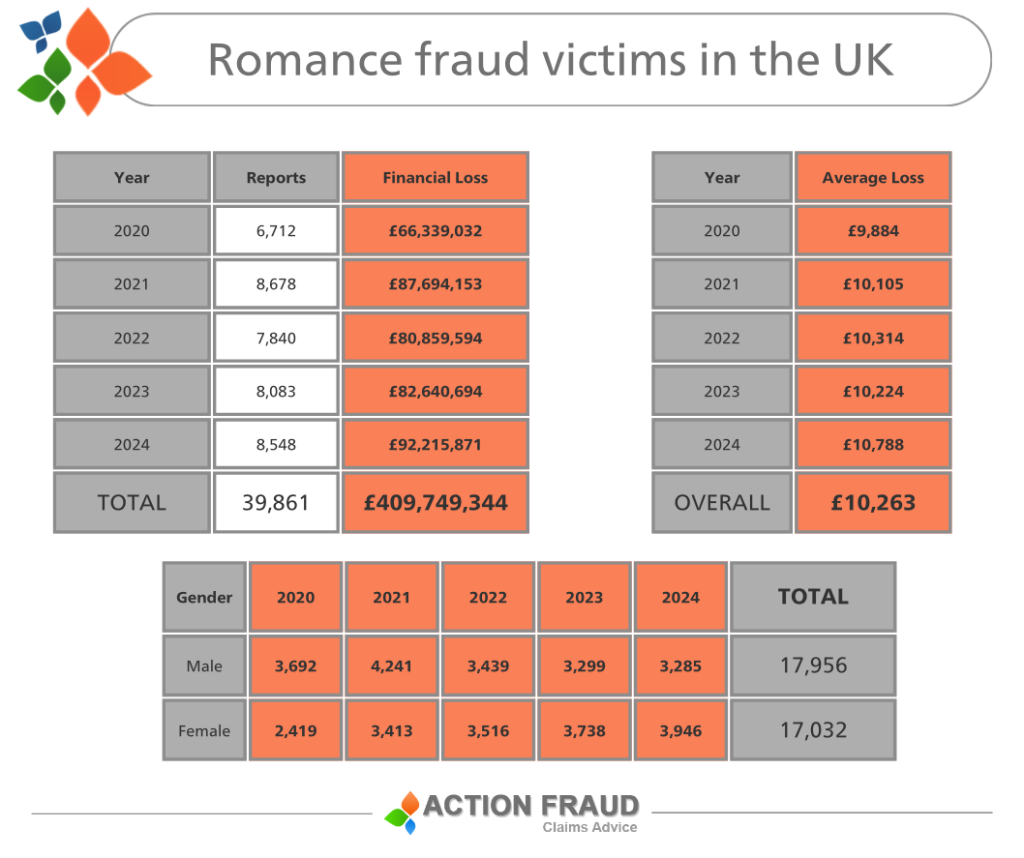
Capital Refund House learned that 39,861 reports were classified as ‘dating fraud’ on Action Fraud’s reporting system across the past five years.
Based on self-reports of losses, a staggering £409,749,344 was taken from scammed members of the public in dating schemes, at an average of over £10,000 per report.
The data shows a 27% rise in reports in that time. 2021, a year in which most relationships had to be pursued online due to lockdown restrictions, saw a massive jump in scams. The 8,678 reports received represented a significant increase compared to the 6,712 cases logged the year before.
After falling to 7,840 in 2022, case numbers have continued to gradually rise. There were 8,083 reports received in 2023, while last year brought 8,548 cases – just 130 short of the 2021 total that had previously appeared to be a significant outlier.
While Valentine’s Day may appear an ideal time for a scammer to prey upon lovelorn members of the public, the data suggests that romance fraud is a year-round threat.
Reports between 14th February and 14th March only exceeded the monthly average once–that was in 2021, when complaints of crime came in at a rate of nearly 27 per day.
Shocking figures show that dating scams spare nobody
What is most telling about the data is that no group can be considered safe from romance scams.
Where the victim’s gender was recorded, 17,956 (51%) identified themselves as female, and 17,032 (49%) identified as male.
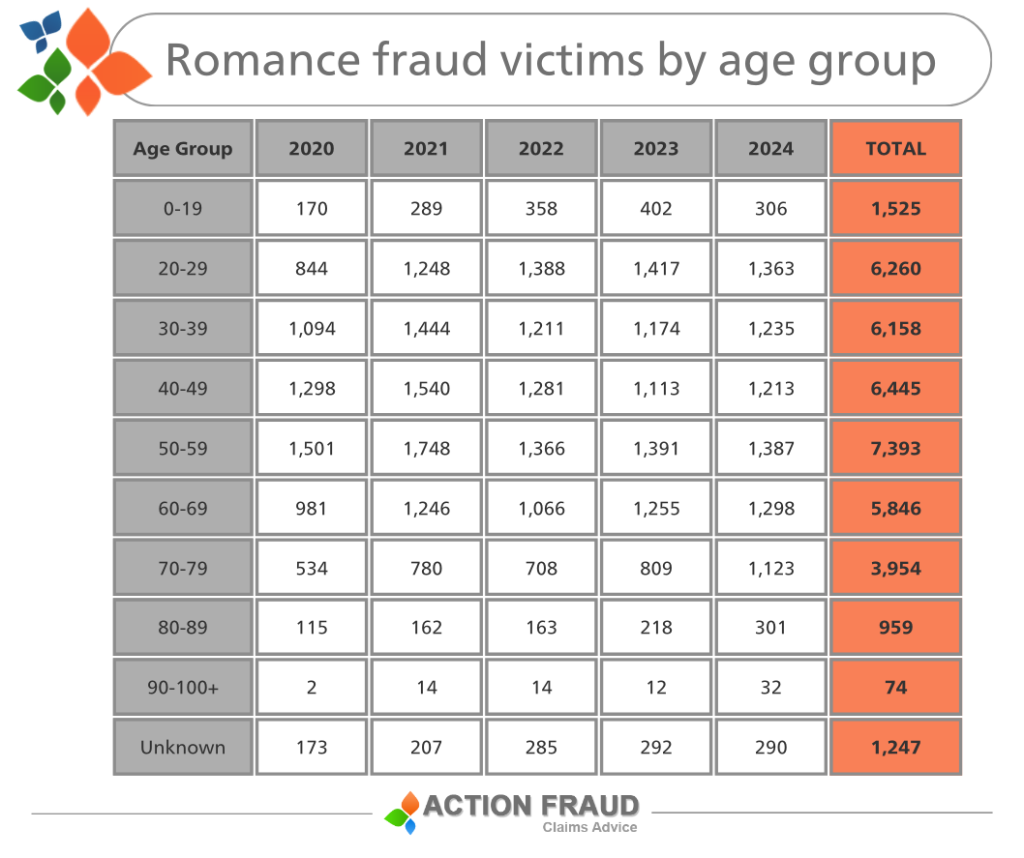
While a victim was more likely to be middle-aged, with 50-59 year-olds scammed on 7,393 occasions (followed by 40-49 year-olds, who reported 6,445 crimes), every age group was represented in the figures.
This includes 73 victims aged between 90 and 99, and even one victim understood to be at least 100 years old.
Shockingly, 53 victims were aged up to nine years old, and a further 1,472 were under the age of 20.
It is another symptom of a growing pandemic of child exploitation online. The NSPCC reported in September that the need for counselling due to online grooming and ‘sextortion’ has grown significantly.
The areas hit hardest by dating fraud
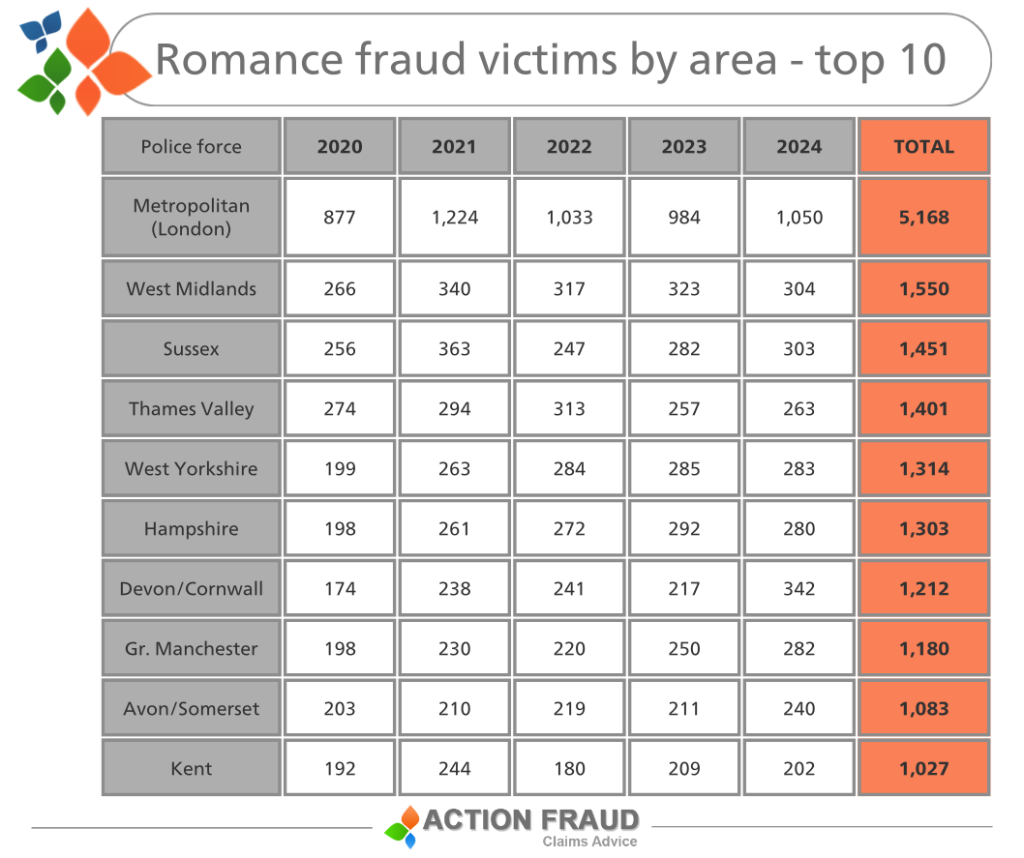
When the reports are broken down by areas covered by each police force, London is highlighted as by far the leading source of reports.
The only force to see more than 1,000 reports in one calendar year–with a four-digit figure for each of the past four years–Metropolitan Police had 5,168 reported dating scams in its area of responsibility.
The 1,224 cases in 2021 were by a distance the highest number of reports in one area in a 12-month period, and it accounted for almost 15% of all dating scams that year.
Second on the list is the West Midlands, with a much smaller–yet still significant–1,550 cases. Sussex (1,451), Thames Valley (1,451) and West Yorkshire (1,314) were all significantly affected.
Dating fraud has increasingly become a cause for concern in Devon and Cornwall, with reports in the region rising by 97% over five years.
In total, ten areas had more than 1,000 reports, meaning that over 200 crimes were being reported every year. In the London area, an average of nearly three victims of romance scams reported their losses every day.
Concerning leap in Nottinghamshire reports
In 2020, Nottinghamshire crimes were reported at a fairly similar rate to Leicestershire. Fast-forward four years and the 2024 tally was almost double that of its neighbouring region.
Only three areas – and only one of which was comparable in size – saw a steeper rise in reports than Nottinghamshire. A 67.5% increase across five years points to a worrying trend in one part of the East Midlands.
Lancastrians also found themselves more at risk of dating fraud in 2024 than they did just a few years before. Reports from Lancashire rose by 56.25%, a rate eclipsing all areas of Yorkshire excluding Cleveland.
The number of reports did not outgrow those of Cheshire, however. From just 88 cases in 2020, Cheshire residents flagged fraud 155 times in 2023, and another 138 last year. It was a similar story for Cambridgeshire, which – like Cheshire – saw almost 60% more cases in 2024 than in 2020.
After back-to-back years of 124 romance fraud reports, the figure for South Wales shot up to 149 for 2024. It was one of just 17 (out of 48) areas where 2024 was the worst year for reports, with 2021 proving to be the peak of dating fraud for most of the UK.


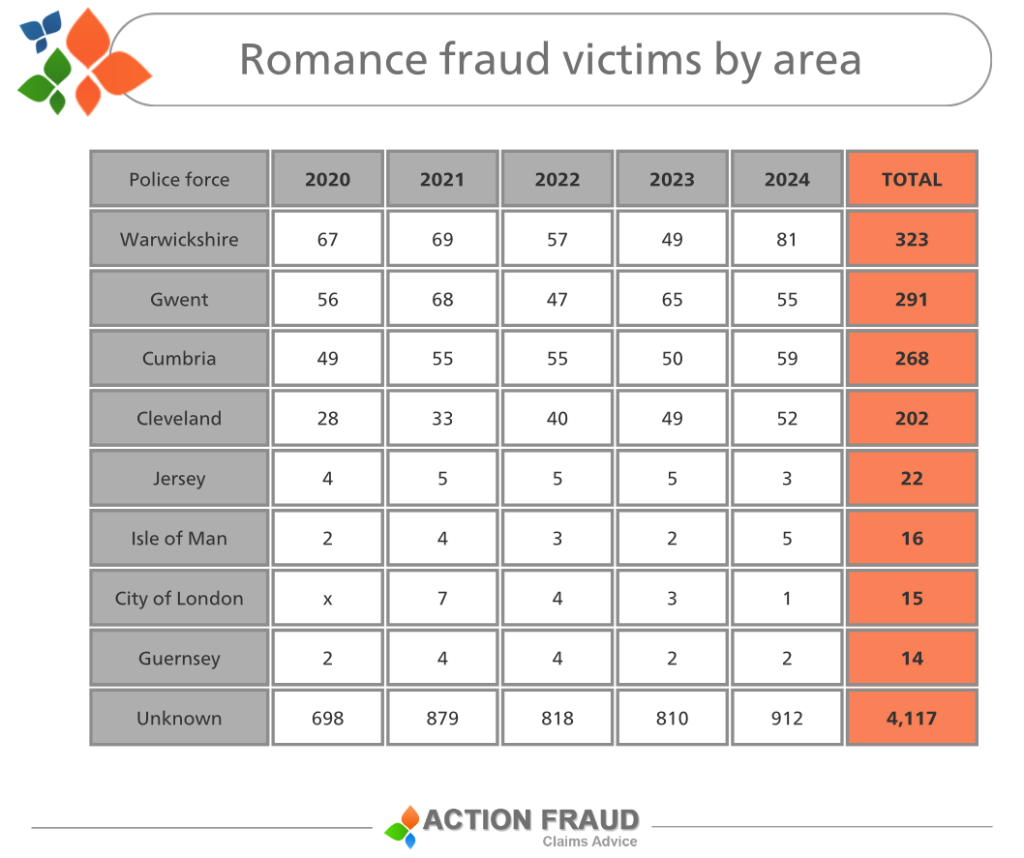
Guernsey, Jersey and Isle of Man all affected
Action Fraud notes that Police Scotland is responsible for gathering reports from Scottish victims. Because reports do not necessarily have to be sent to Action Fraud, the ‘true’ number of dating scams in Scotland is likely to be much larger than the 507 recorded here. However, even this limited data set outlines how 2021 and 2024 were especially troublesome years for police combating romance fraud.
Cleveland, North Yorkshire, saw reports of dating scams fly up by nearly 86%. In 2024, 52 people in the region told the authorities that they had been scammed by who they believed was a romantic partner.
Humberside also saw a startling increase (nearly 55%). Conversely, Gwent had almost the same number of reports in 2024 as they did four years before.
The geographical breakdown proves that there were no exemptions when it came to dating scams. 14 Guernsey residents fell victim to romance fraud, while there were 16 reports from the Isle of Man and 22 from Jersey.